
1st Screen Lock v6.4 serial key or number
1st Screen Lock v6.4 serial key or number
1st Screen Lock v6.4 crack keygen
All cracks and keygens are made by enthusiasts and professional reverse engineers

IMPORTANT NOTICE: All staff like keygens and crack files are made by IT university students from USA, Russia, North Korea and other countries. All the files were checked by professors and were fully verified for compatibility with Windows OS, MAC OS and *nix systems like Linux and Unix
Yes indeed, it is our loved Asher. He was born in sunny Suriname and his hobby was cracking and hacking.
He got his master degree in computer science at Yale University and became one of the most popular reverse engineers.
Later he moved to Sweden and continued cracking software and at the age of 52 he finally cracked the protection system of 1st Screen Lock v6.4 and made it available for download at KEYGENS.PRO
He was a fan of such great hackers as Jace and Bryson. At the moment he teaches at University of California, Berkeley and doesn't forget about reversing art.
Fetching...done. Download 1st Screen Lock v6.4 crack/keygen with serial number
It`s free and safe to use all cracks and keygens downloaded from KEYGENS.PRO So download 1st Screen Lock v6.4 keygen then unzip it to any folder and run to crack the application. There are no viruses or any exploits on this site, you are on a crack server optimized for surfer.
Sometimes Antivirus software may give an alert while you are downloading or using cracks. In 99.909% percent of cases these alerts are false alerts.
You should know that viruses and trojans are created and distributed by the same corporations developing AntiVirus software, they just create a job for themselves. The same problem may occur when you download 1st Screen Lock... product keygens. Again, just relax and ignore it.
The time of download page generation is more than zero seconds. Use downloaded crack staff and have a fun, but if you like the software in subject - buy it ;)...don't use cracks.
This site is running on UNIX FreeBSD machine. It is a state of the art operating system that is under BSD license and is freeware. Don't waste your time with shitty windows applications, use real staff and be cool :)

If you've changed the location where you saved a track, the message [File is Missing] is displayed, and you may not be able to play or export the track. (The status column is marked with [!].)
In this case, you can [Auto Relocate] or [Relocate] the track.
[Auto Relocate] searches and relocates files in the folder specified by you in the [Preferences] > [Advanced] > [Database] > [Auto Relocate Search Folders].
[Relocate] enables you to manually specify the location of the file and relocate it.
Follow the instructions in either of the following two ways:
- From the application menu
Select [File] > [Display All Missing Files] in the application menu. In the [Missing File Manager] window, click either the [Auto Relocate] or [Relocate] button.
After selecting the track with [!], right-click to show the context menu and select [Auto Relocate] or [Relocate].
https://rekordbox.com/en/support/faq/v6/#faq-4819
Источник: [https://torrent-igruha.org/3551-portal.html]Hyundai Sonata
The Hyundai Sonata (Korean: 현대 쏘나타) is a mid-size car produced by the South Korean manufacturer Hyundai since 1985. The first generation Sonata, which was introduced in 1985, was a faceliftedHyundai Stellar with an engine upgrade, and was withdrawn from the market in two years due to poor customer reactions.[2] While the nameplate was originally only sold in South Korea,[3] the second generation of 1988 was widely exported.[4][5] The Sonata is now built in the United States for the North American market, China and South Korea for the Asian market, and Russia for other markets. It was named for the musical term sonata, and has been referenced as such at least once in Hyundai advertisements.
First generation (Y1; 1985–1987)[edit]
The first Sonata was introduced to compete with the Daewoo Royale series and was a more luxurious version of the Stellar. It included cruise control, power seats, head lamp washers, power brakes, electric operated adjustable side mirrors and chrome bumper trims. The Sonata was available with two trim options in Korea: Luxury and Super (the latter only available with a 2.0-liter engine). In the domestic market Hyundai attempted to sell the Sonata as an executive car using catchphrases like "Luxury car for VIP"; however, as the Sonata was based on the Stellar without any redesigning it was seen by the public as no different than a luxury version of the Stellar. In 1987 Hyundai added two tone color schemes and a trip computer option but sales soon went down and the car was discontinued in December of that year. The Sonata was sold only in the South Korean domestic markets. The vehicle was unveiled in South Korea on 4 November 1985.
Engine choices included 1.6-liter Mitsubishi Saturn (only available outside the domestic market), 1.8- and 2.0-liter Mitsubishi Siriusinline-fours. The latter unit also found its way into the 1987 and later Stellar, and in MPI form the 1986 Hyundai Grandeur. The body was a largely unchanged Hyundai Stellar.[6]
It was sold in New Zealand (right hand drive)[citation needed] with the 1.6-liter Mitsubishi engine with the five-speed manual gearbox; an automatic transmission was an optional extra. The original importer was a unit of the Auckland-based Giltrap Motor Group.
The final version of the Stellar was known as the Stellar 88 and was launched to celebrate the 1988 Summer Olympics in Seoul. Afterwards, Hyundai discontinued the Stellar and replaced it with the all-new Sonata.[7]
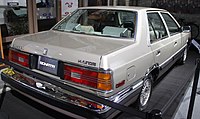
1987 Hyundai Sonata (South Korea)
Second generation (Y2; 1988–1993)[edit]
The Y2 Sonata was part of Hyundai's expansion in North America after the success of the Excel. It was introduced in South Korea on 1 June 1988.[8] It was then introduced in Canada in September 1988 as a 1989 model, on 14 November 1988 in the United States as a 1989 model, and in March 1989 in Australia. The exterior was designed by Giorgetto Giugiaro of ItalDesign. The vehicle received a mid-term facelift in 1991. It replaced the Stellar as Hyundai's large family car. Sonatas were built in Ulsan, Korea, and in Bromont, Quebec.
The Sonata was launched in Europe in June 1989, as the third model to be sold there following the Hyundai brand's European launch in 1982. It was aimed at buyers of cars including the Ford Granada Scorpio, but was priced to compete with smaller cars like the Ford Sierra.
The Sonata was designed by Hyundai and featured Mitsubishi's engineering, including the platform from the Galant Σ and its 2.4-liter, the Mitsubishi-designed engines were made under license in Korea, and had Hyundai codes stamped on them, but otherwise were almost identical to motors used by Mitsubishi 110 hp (82 kW) Sirius inline-four engine as used in American-market models. A 3.0-liter V6 engine based on the Mitsubishi 6G72 arrived in 1990. Other markets received 1.8- and 2.0-liter engines carried over from the first generation, but equipped with Hyundai's own MPI, replacing their carbureted counterparts used in the Y1 Sonata. The U.S. model received the DOHC 2.0-liter G4CP engine for the 1992 model year, replacing the original 2.4-liter SOHC G4CS engine.[6]
Trim levels offered in the US:
- GL (1989-1991 with a 2.4 single overhead cam engine [G4CS], 1992-1993 2.0 DOHC engine [G4CP])
- GLS (3.0-litre V6 engine)

Hyundai Sonata (Canada; pre-facelift)

Hyundai Sonata (Spain; facelift)
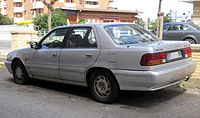
Hyundai Sonata (Spain; facelift)
Third generation (Y3; 1993–1998)[edit]
The Y3 Sonata debuted in 1993. The base engine in most markets was a 2.0-liter 77 kW (103 hp) Sirius inline-four, but there was a 3.0-liter, 107 kW (143 hp) Mitsubishi V6 option in some markets. This generation continued after the demise of the Bromont, Quebec plant in September 1993. After that, all Sonatas would be built in Korea, until the opening of the Beijing Hyundai plant in December 2002.
The third generation Y3 model was also produced as the Hyundai Marcia between 1995 and 1998, selling alongside the Sonata in South Korea only. The Marcia differed from the Sonata with its restyled front and rear fascias.

1996 Hyundai Marcia (South Korea)

1996 Hyundai Marcia (South Korea)

1994–1996 Hyundai Sonata (Australia)
Facelift (1996–1998)[edit]
A facelift for the Y3 in 1996 saw modifications to the front and rear. The four-cylinder engine output was also increased to 92 kW (123 hp) for that year as well. The Y3 facelift was the last Sonata produced in Ulsan.

Facelift Hyundai Sonata (Y3; US)

Facelift Hyundai Sonata (Y3; Chile)
Fourth generation (EF; 1998–2004)[edit]
| Fourth generation (EF) | |
|---|---|
 | |
| Overview | |
| Also called | Hyundai Sonica (Italy) Hyundai Sonata Vivante (South Africa) Hyundai Sonata Prima (Egypt) Hyundai Moinca (China) Hyundai Sonata Gold (India) |
| Production | 1998–2004 (South Korea) 2001–2005 (India) 2002–2017 (China) 2005–2012 (Russia) |
| Assembly | Asan, Korea Gaborone, Botswana (TMBC)[9] Chennai, India Cairo, Egypt (AAV) Beijing, China (facelifted version) Taganrog, Russia (TagAZ; facelifted version)[10] |
| Body and chassis | |
| Platform | Hyundai-Kia Y4 |
| Related | Kia Optima |
| Powertrain | |
| Engine | 1.8 L G4GB I4 (China) 2.0 L G4GC I4 (China) 2.4 L Sirius I4 2.5 L Delta V6 (pre-facelift) 2.7 L Delta V6 (facelift) |
| Transmission | 4-speed automatic 5-speed manual |
| Dimensions | |
| Wheelbase | 2,700 mm (106.3 in) |
| Length | Pre-facelift: 4,710 mm (185.4 in) Facelift: 4,745 mm (186.8 in) |
| Width | Pre-facelift: 1,815 mm (71.5 in) Facelift: 1,820 mm (71.7 in) |
| Height | Pre-facelift: 1,410 mm (55.5 in) Facelift: 1,420 mm (55.9 in) |

The new EF series Sonata arrived in 1998, debuting the new Hyundai-Kia Y4 platform. Compared to the Y3 predecessor, the EF grew ever so slightly in size, but shared the same 2,700 mm (106.3 in) wheelbase. It also introduced double wishbone front suspension and independent, multi-link rear suspension. Initial engines from launch were the 2.0-litre with 136 hp (101 kW), and a 2.5-litre with 168 hp (125 kW)—the G6BW model of Hyundai Delta V6.
The EF Sonata shares its underpinnings with the Hyundai Trajet and first-generation Hyundai Santa Fe, which became the company's first compactcrossover SUV. The first generation Kia Optima (called the Magentis outside of the United States) was also based on the EF Sonata, and while both shared the same doors and roof panels, the Optima took a squarer approach in design.
Facelift (2001–2004)[edit]


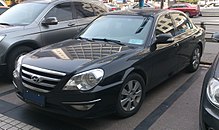
Hyundai issued a significant facelift for the EF series in 2001 for the 2002 model year, known as the EF-B series.
With the facelift brought a redesigned front end featuring a new bonnet, grille and quad ovoid headlights, while the rear featured rounded tail-lights and a repositioned rear vehicle registration plate alcove from the bottom bumper to the trunk lid. Inside, a redesigned dashboard and newly shaped seats take place.
Amid a below-par safety rating, Hyundai strengthened the body shell and firewall, widened the rear track, included anti-submarining front seat pans and added thicker front brake discs for the update.
Engine wise, the EF-B model featured an all-aluminum, G6BAY series 2.7-litre Delta V6 with 177 hp (132 kW). It also featured the same Sirius II 2.4-litre inline-four rated at 139 hp (104 kW) and 150 lb⋅ft (200 N⋅m) of torque.
This generation of Sonata is still being built (since 2002) and sold in China from December 2002, by Beijing Hyundai. A facelifted Sonata was produced by that company in August 2009 called the Moinca. This model is only available in the Chinese market and comes with a 1.8 or 2.0 litre engine with transmission choices consisting of a five-speed manual or a four-speed automatic.[11]
The Sonata was produced by TagAZ in Russia until 2012.[12]
Fifth generation (NF; 2004–2009)[edit]
| Fifth generation (NF) | |
|---|---|
 | |
| Overview | |
| Also called | Hyundai NF (Russia) Hyundai NF Sonata (Russia, facelifted version) Hyundai Sonata Embera (India) Hyundai Sonica (Italy) Hyundai Sonata CNG (Thailand) |
| Production | 2004–2009 2005–2010 (North America) 2005–2011 (China) 2006–2010 (Thailand) |
| Model years | 2005–2009 2006–2010 (North America) 2006–2011 (China) 2007–2010 (Thailand) |
| Assembly | Asan, South Korea Montgomery, Alabama, United States Chennai, India Beijing, China İzmit, Turkey (Hyundai Assan) Cairo, Egypt (Ghabbour Group) Thonburi, Thailand (TAAP)[13] Al Jazirah state, Sudan (Giad)[14] |
| Designer | Choi Jong Min (2002)[15] |
| Body and chassis | |
| Related | Kia Optima |
| Powertrain | |
| Engine | 2.0 L ThetaI4 2.0 L ThetaI4 (Petrol/CNG) 2.4 L Theta I4 3.3 L LambdaV6 2.0 L CRDi I4 |
| Transmission | 4-speed automatic 5-speed manual 6-speed manual (2.0 CRDI) 5-speed automatic |
| Dimensions | |
| Wheelbase | 2,730 mm (107.5 in) |
| Length | 4,800 mm (189.0 in) Sonata Ling Xiang:4,815 mm (189.6 in) |
| Width | 1,830 mm (72.0 in) |
| Height | 1,475 mm (58.1 in) |

The NF Sonata was launched in August 2004 in Korea, based on a new platform created from the project NF. The company's first all-aluminum I4 engine, dubbed Theta, debuted in the new Sonata. Engine choices at launch were a 2.4-liter I4 rated 164 hp (122 kW) at 5800 rpm and a 3.3-liter V6 rated 237 hp (177 kW) V6. In Korea, the 2.4-liter option was sold as the F24S (24 = 2.4L, S = Special). The 2.0-liter gasoline version was only sold in Korea and proved more popular there due to added gas, tax and insurance savings. Diesel versions are available in Europe, New Zealand and Singapore, where they are a popular replacement for the Toyota Comfort taxi cab.
The U.S. May 2005 launch of the new Sonata coincided with the production commencement at the company's first U.S. assembly plant, in Montgomery, Alabama.
Classified by the U.S. Environmental Protection Agency as a mid-size car, the fourth generation was 2 in (51 mm) longer and taller and 1 in (25 mm) wider than the previous generation. Standard features in U.S. models included anti-lock braking system/electronic stability control/traction control system as well as six airbags (driver/front passenger front and side, and side curtain).[16]
Safety[edit]
Europe: 2006 year models received the following European New Car Assessment Program (Euro NCAP) ratings:
In Insurance Institute for Highway Safety tests the Sonata received a "Good" overall in the frontal impact crash test, an "Acceptable" overall score in the side impact crash test, and a "Good" rating for rear crash protection. In the roof strength evaluation 09 and 10 models were rated "Marginal".[17]
2006 Hyundai Sonata tested by the U.S. National Highway Traffic Safety Administration (NHTSA):[18]
Facelift (2008–2010)[edit]
The redesigned vehicle was unveiled at the 2008 Chicago Auto Show as a 2009 model year vehicle.[19] The production version was sold as the Hyundai Sonata Transform in Korea, and the model debuted elsewhere as an 'early' 2009 model.
The styling was done primarily at Hyundai-Kia America Technical Center, Inc. (HATCI) in Superior Township, Michigan in 2006.[20]
The redesign features revised engines, front fascia and chrome 3 bar grille, taillights (turn signals became red in North America only), jewel-projector headlights, new 10-spoke alloy wheel design for the Limited models (as opposed to sharing the 5-spoke design from the SE model), and an extensively revised IP (Instrument Panel).[21] Hyundai adopted "slush molding", a production technique that enables a much higher grade of texturing and shaping of the IP surface.[22]
Redesigned gauges feature a blue backlight, and a touch-screen navigation system, optional on the Limited trim level only, includes satellite radio capability.[23] Bluetooth capability is available as an optional unit, separate from the audio or navigation system, and all models include both a USB port along with an auxiliary input jack. An optional USB adaptor cord allows integration of an iPod, and chrome interior door handles are standard on the Limited trim.
The 2.4-liter G4KCTheta engine was rated 162 hp (121 kW) at 6000 rpm and 164 lb⋅ft (222 N⋅m) (164 hp (122 kW) for PZEV model), 2.0-liter G4KA Theta engine was rated 143 hp (107 kW) at 6000 rpm and 140 lb⋅ft (190 N⋅m) at 4250 rpm and the 3.3-liter Lambda V6 was rated 235 hp (175 kW) at 6000 rpm and 229 lb⋅ft (310 N⋅m) at 4500 rpm.
The Diesel engine (D4EA) variant is available for the UK market with the option of 4-speed automatic or 6 speed manual, and was introduced into the Australian market for the first time, replacing the V6 option.
The base model GLS is available with a manual five-speed transmission. GLS, SE and Limited models feature a newly available, manually shiftable five-speed automatic transmission marketed as "Shiftronic."
There are minimal changes for the 2010 model, which includes the optional navigation system on the SE as opposed to being a Limited-exclusive option, and the V6 engine is no longer offered on the GLS model.
Pre-facelift styling


Post-facelift styling


Sonata Ling Xiang[edit]
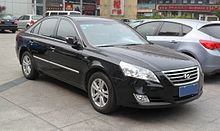
Beijing Hyundai launched a redesigned Sonata called the Ling Xiang, also known as NFC Sonata, for the Chinese market. Production commenced in December 2008 for the 2009 model year. This variant has an updated exterior and revised rear seating.[24] Following Hyundai's success with their Hyundai Elantra Yue Dong, Ling Xiang was created specifically to target the Chinese market. Hyundai first introduced this car to the market at The 6th China Guangzhou International Automobile Exhibition in 2008.[25]
Engine and transmission choices include the 2.0 litre and 2.4 litre Theta engine paired to 3 gear separate gearboxes, a 5 speed manual, 5 speed automatic and 4 speed automatic. Trim levels consisted of the 2.0GL Manual and Automatic, 2.0 GLS Manual and Automatic, 2.0 DLX AT, 2.0 Top, 2.4 GLS, 2.4DLX AT and 2.4 Top.
Sixth generation (YF; 2009–2014)[edit]
| Sixth generation (YF) | |
|---|---|
 | |
| Overview | |
| Also called | Hyundai i45 Hyundai Sonata Sport (Thailand) |
| Production | 2009–2014 2010–2015 (Hybrid) 2011–2014 (Thailand) |
| Model years | 2010–2014 2011–2014 (North America) 2012–2014 (China) |
| Assembly | South Korea: Asan United States: Montgomery, Alabama China: Beijing (Beijing Hyundai) |
| Designer | Andre Hudson (2007) |
| Body and chassis | |
| Related | Kia Optima/Magentis/K5 Hyundai i40[26] |
| Powertrain | |
| Engine | 2.0 L NuCVVLI4 2.0 L Theta 163 hp (122 kW), I4 2.0 L Theta TurboGDi, 274 hp (204 kW), I4[27] 2.4 L Theta II 176 hp (131 kW), I4 2.4 L ThetaGDi, 200 hp (150 kW), I4 |
| Transmission | 6-speed automatic 6-speed manual |
| Dimensions | |
| Wheelbase | 2,795 mm (110.0 in) |
| Length | 4,820 mm (189.8 in) |
| Width | 1,835 mm (72.2 in) |
| Height | 1,470 mm (57.9 in) |
| Curb weight | 1,451–1,504 kg (3,199–3,316 lb) (2.4L) 1,514–1,566 kg (3,338–3,452 lb) (2.0L Turbo) |
Hyundai commenced development of the YF Sonata in 2005, with a development cost of ₩450 billion (US$372 million). In the Australian,[28] New Zealand, Singapore, and Colombian markets, the YF is retailed under the name Hyundai i45, following the alphanumeric i-series nomenclature established by Hyundai in these markets. The vehicle was badged as a "Sonata" in Eastern Europe, just as in North America and South Korea.
Sales of the YF Sonata in South Korea began on 2 September 2009, before the production vehicle's South Korean launch.[29] The US version of the sixth generation Sonata was unveiled at the 2009 Los Angeles Auto Show, with sales beginning in 2010 for the 2011 model year. The Sonata was the second vehicle, after the Tucson, to carry Hyundai's then-radical "Fluidic Sculpture" design language.[30]

For the US market, the sixth generation Sonata boasted a direct-injection 2.4-liter four-cylinder engine. This new engine improves fuel economy and produces a maximum of 200 PS (147 kW; 197 hp) at 6300 rpm and 25.5 kg⋅m (250 N⋅m; 184 lb⋅ft) at 4250 rpm.[31] It is part of the Theta II engine lineup. Furthermore, a timing chain was introduced along with a new six-speed automatic transmission.[32] This Sonata is built with hot-stamped ultra high-strength steel. In South Korea, the YF Sonata is delivered with a 2.0-liter Theta II MPi gasoline engine (Max output 165 PS (121 kW; 163 hp), Max torque of 20.2㎏·m). Its fuel economy has improved 11%. A direct-injection 2.4-liter four cylinder engine and a 2.0 turbocharged engine was available.
Exclusive options for the Korean model includes a three-piece panoramic moonroof, electroluminescent instrumentation, fender-mounted turn signals, and a special Premier Beige model. Upgraded audio uses a JBL system, and certain navigation packages come with a telecommunications system with Hyundai's Mozen system.
For the North American model, GLS, SE, and Limited trims were offered. A six-speed manual transmission came standard on the GLS, and a six-speed automatic is available. Differences with the Korean model include differences with the GLS model, which features a body-colored grille and door handles, and different steel wheel covers. Limited models and optional stereos on the GLS and SE now have "Dimension" audio systems, and the Limited trim has an optional Infinity stereo. Limited models have standard front and rear heated seats, the first such offering in this segment.[33] Additional differences include different cupholders, a redesigned straight leather shifter as rather than the gated one on Korean models, and an additional exterior color choice, Indigo Blue Pearl. The 6th Hyundai Sonata was awarded Top Safety Pick from Insurance Institute for Highway Safety (IIHS) in the United States.[34] The Sonata 2.0T was released in December 2010.
For the 2012 model year, Hyundai's new Blue Link system was offered as standard equipment, and the Limited model included a new standard three-piece panoramic sunroof. SE models had an optional backup camera included with navigation packages, and navigation systems included a new 7-inch display from the previous 6.5-inch.
For 2013, the list of standard features was changed slightly, including heated front seats on SE models, and heated rear seats on Limited models. An automatic transmission also came standard on GLS models, the manual was no longer offered. The GLS Popular Equipment Package now included fog lights and heated front seats. The Limited trims now no longer included the panoramic sunroof, but instead included a standard size sunroof. A panoramic sunroof offered on the Limited Premium Package.[35]
In January 2013 the i45 was discontinued in Australia following slow sales and limited supplies. In turn, the expanded i40 range filled the gap left by the i45. The i45 has also been discontinued in Colombia, and replaced with the smaller i40 sedan, leaving Singapore and New Zealand as the only two markets still selling the vehicle under the i45 name at that time.
Facelift (2012–2014)[edit]
In 2012, the Korean-produced Sonata received a mild mid-life facelift. Exterior changes include a new grille, slimmer LED mirror indicators, new front fog lights incorporating LED daytime running lamps (DRLs), new alloy wheel designs, as well as redesigned LED taillights. Interior changes include a new color touchscreen display for audio systems (on certain models), as well as redesigned dual-zone automatic climate controls, which now incorporate a small LCD display. A Driver Selectable Steering Mode was standard on all trims. Front parking sensors are now available on certain models, as well as an electronic parking brake. The facelifted model was first released in Korea in 2012, followed by international markets in early 2013. North American produced Sonatas received a facelift in late 2013, for the 2014 model year.
Gallery[edit]
Pre-facelift styling


Post-facelift styling


Safety[
What’s New in the 1st Screen Lock v6.4 serial key or number?
Screen Shot

System Requirements for 1st Screen Lock v6.4 serial key or number
- First, download the 1st Screen Lock v6.4 serial key or number
-
You can download its setup from given links:

1st Screen Lock v6.4 serial key or number & Kali Software Crack

1st Screen Lock v6.4 serial key or number& Software

1st Screen Lock v6.4 serial key or number
About Author
